
Your Child Turned 18: Three Legal Documents Every Florida Family Should Have
Turning 18 is an exciting milestone. Your child may be preparing for college, starting a career, moving into an apartment, traveling, or becoming more financially independent.
But something important changes on their eighteenth birthday: your child becomes a legal adult.
Even when your child remains on your health insurance, lives in your home, or depends on you financially, you may no longer have automatic legal authority to access private medical information, make health care decisions, or handle financial matters on your child’s behalf.
That can become a serious problem during an illness, accident, hospitalization, or other emergency.
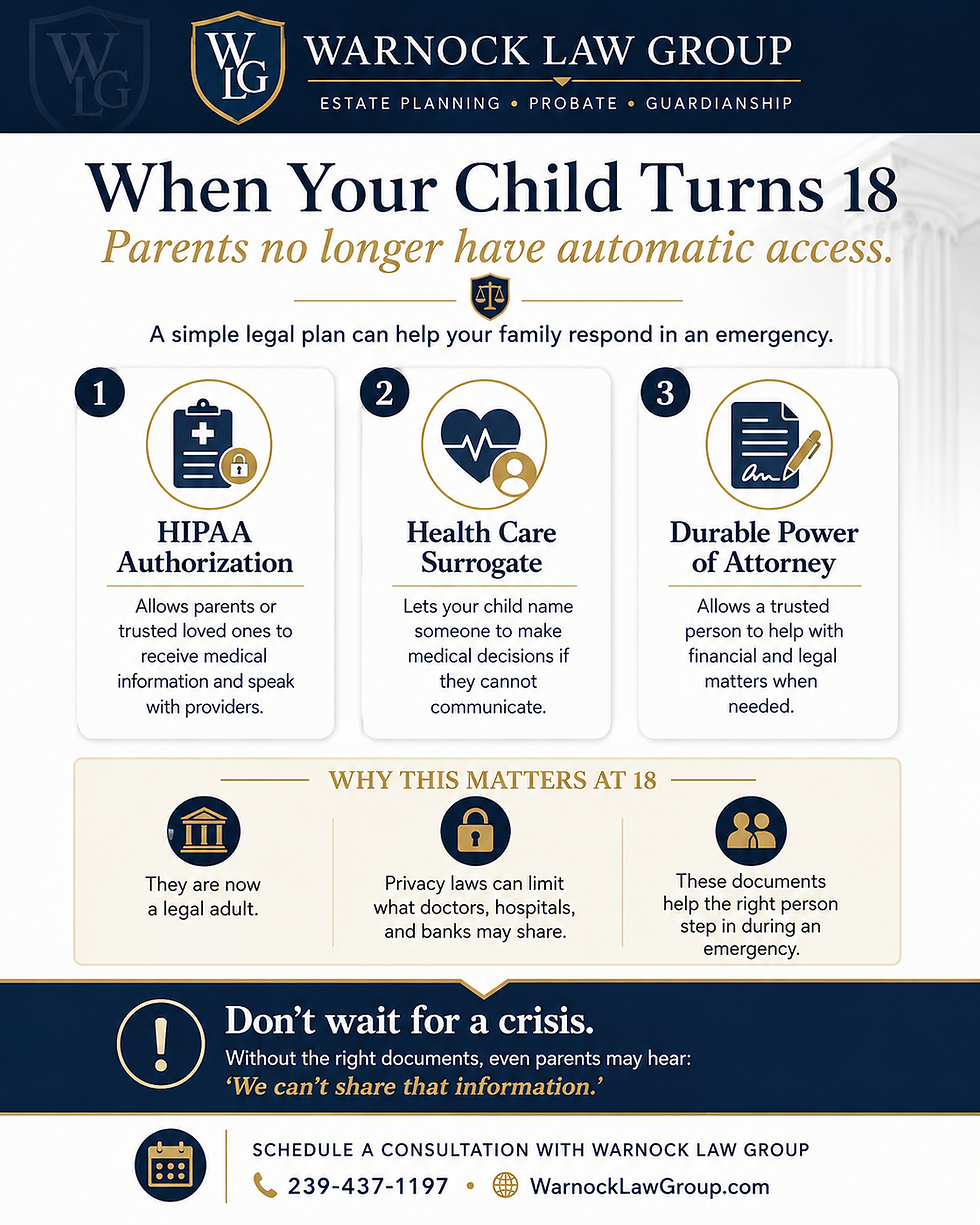
Fortunately, a few carefully prepared legal documents can allow your adult child to choose who may receive information and step in when assistance is needed.
1. HIPAA Authorization
The Health Insurance Portability and Accountability Act, commonly known as HIPAA, protects the privacy of a patient’s medical information.
Once your child is an adult, doctors, hospitals, therapists, pharmacies, and other health care providers are not generally required to disclose information to a parent simply because of the parent-child relationship. A provider may sometimes share limited information when the patient agrees or when the provider determines that disclosure is in the patient’s best interests, but families should not rely on an exception during an emergency.
A properly drafted HIPAA authorization allows your child to identify the people who may:
Speak with doctors and other medical providers;
Obtain medical records;
Receive information about diagnoses and treatment;
Discuss insurance and billing issues; and
Communicate with a hospital during an emergency.
The authorization does not transfer control over your child’s health care. It simply permits the disclosure of information to the individuals your child has selected.
Without written authorization, a parent calling a hospital may hear: “We cannot confirm whether that person is a patient,” or “We cannot discuss the patient’s condition with you.”
2. Designation of Health Care Surrogate
What many people call a “medical power of attorney” is generally known in Florida as a Designation of Health Care Surrogate.
This document allows your adult child to appoint a trusted person to make health care decisions if your child cannot make or communicate those decisions personally. The document can also authorize the surrogate to receive health information, and Florida law permits the document to make some or all of that authority effective immediately if the document expressly provides for it. Fla. Stat. § 765.202.
A health care surrogate may be authorized to:
Consult with physicians;
Consent to or refuse medical treatment;
Select health care providers and facilities;
Obtain medical information;
Apply for benefits to help pay for care; and
Carry out the patient’s stated medical wishes.
Your child should also name an alternate surrogate in case the first person is unavailable.
Won’t a parent automatically be allowed to make decisions?
Not necessarily.
When an incapacitated Florida patient has no designated surrogate, state law provides a priority list of potential proxy decision-makers. A previously appointed guardian is first, followed by a spouse, adult children, parents, adult siblings, certain other relatives, and close friends. A parent may therefore be able to act in some circumstances, but the parent is not always first in line. Disagreements, unavailable family members, or uncertainty about who has authority can delay important decisions. Fla. Stat. § 765.401.
A written designation lets your child decide who should act instead of leaving that decision to a statutory hierarchy.
3. Durable Power of Attorney
A Durable Power of Attorney addresses financial and legal matters rather than medical decisions.
The document allows your adult child, known as the principal, to appoint an agent to act within the authority specifically granted in the document. Depending on how it is drafted, the agent may be able to:
Communicate with banks and financial institutions;
Pay bills;
Handle insurance claims;
Access or manage financial accounts;
Sign documents;
Deal with landlords or utility providers;
Address tax matters;
Manage personal property; and
Conduct other necessary financial transactions.
The word durable is important. A properly drafted Florida durable power of attorney remains effective despite the principal’s later incapacity. Fla. Stat. § 709.2104.
Florida powers of attorney are generally effective when signed. With limited exceptions, a new Florida power of attorney cannot simply be written to “spring” into effect only after a future incapacity. The document must therefore be drafted carefully, and the agent should be someone the young adult trusts completely. Fla. Stat. § 709.2108.
Florida also imposes specific signing requirements. A power of attorney must generally be signed by the principal, witnessed by two subscribing witnesses, and acknowledged before a notary public. Fla. Stat. § 709.2105.
An Additional Document for College Students: FERPA Authorization
Families with college students should also consider the Family Educational Rights and Privacy Act, or FERPA.
Once a student turns 18—or begins attending a postsecondary institution at any age—rights concerning the student’s education records generally transfer from the parent to the student. That means a college may restrict a parent’s access to grades, disciplinary records, academic information, and certain other student records unless the student authorizes disclosure or another exception applies.
Many colleges provide their own FERPA authorization form. Students and parents should review the institution’s procedures before the school year begins.
Why These Documents Should Be Completed Before an Emergency
These documents must be signed while your child has the legal capacity to understand and execute them.
After a severe accident, loss of consciousness, mental health crisis, or serious illness, it may be too late to create the necessary documents. The family may then be forced to rely on limited statutory authority, negotiate with institutions individually, or pursue a court-supervised guardianship.
Planning in advance is usually simpler, less expensive, and less stressful.
These Documents Do Not Take Away Your Child’s Independence
Young adults sometimes worry that signing these documents means giving up control.
It does not.
Your adult child remains the primary decision-maker while able to act. The documents simply establish who may receive information or provide help when requested or when the young adult cannot act independently.
Your child may also decide:
Whom to appoint;
Which powers to grant;
Whether to name alternates;
Whether health-information authority is immediate;
What limitations to include; and
When to revoke or replace the documents.
The objective is not parental control. It is ensuring that the people your child trusts can help without unnecessary legal barriers.
A Practical Eighteenth-Birthday Legal Checklist
When a child turns 18, families should consider completing:
A HIPAA authorization;
A Designation of Health Care Surrogate;
A Durable Power of Attorney; and
A FERPA authorization when the child attends college.
Copies should be provided to the appointed individuals and stored somewhere accessible. Your young adult may also wish to keep electronic copies available through a secure cloud account or emergency-information application.
Help Your Young Adult Prepare for the Unexpected
An eighteenth birthday is an appropriate time to begin basic estate and incapacity planning—even when the young adult owns few assets.
The Warnock Law Group can help Florida families prepare legally compliant documents tailored to the young adult’s circumstances and wishes. We can explain each appointment, discuss appropriate safeguards, and make sure the documents are executed correctly.
Contact The Warnock Law Group at 239-437-1197 to schedule a consultation for your family’s young-adult planning documents.


Comments